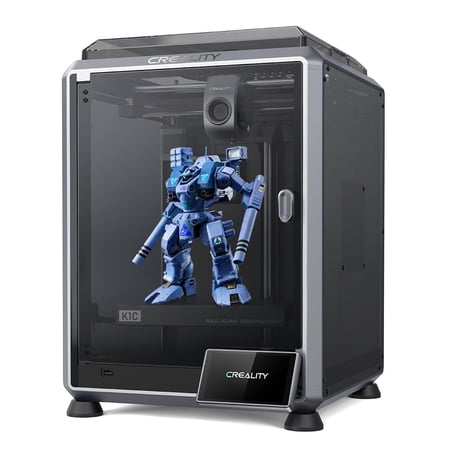
It's a decent printer but it went out the door too soon. I imagine the engineers, after doing the first assembly of this new version and discovering that the lid can't be fully seated (two corners will always float above the magnetized landing bolts) yelling, "CR@P! Who was in charge of that?!" And then qualifying with, "Well, OK, maybe the User won't notice," before running a Self-Check, then yelling, "CR@P!" for a second time when the cable guide banged against the lid. But, upper management says, "Ship it anyway! We're already way over budget on this <expletive> thing!!"
That's just my imagined scenario. And, it IS a decent printer, despite these glaring oversights. It's fairly easy to use, and it networked easily from the Creality slicer. Though I wasn't able to get it to network with Orca, so I use a thumbdrive to transfer G-code to the printer. Why am I using Orca instead of the Creality slicer? Because, there are features in Orca that I couldn't find in the Creality slicer (though, apparently there is a new version of the Crealty that might be better)--features like Scarf Joint Seam and Infill patterns (Orca has patterns like "adaptive cubic" and "gyroid") Also, Orca is just laid out better. Also, the Crealty slicer has "Chinese English" that is at times challenging to interpret.
It seems solidly built and I've been using it off and on for over a month now, and it's holding up. But, here's another con:
- The filament must be hung on the back and fed in from behind the printer, so that tends to require a lot of "reaching around" to get to the filament spool and to feed or remove the filament. The printer does come with G-code for printing a spool holder that can be mounted on the side, but heck, I paid $600 for this printer, so why should I have to spend more money and time to add this feature?!? Also, the filament has to travel around multiple bends making it impossible to use any sort of brittle filament, like wood infused. I had a print pause because a PLA filament broke on me (end of the spool so it was very curled, but still, shouldn't happen -- and this was Creality Approved filament, too).
A Pro: This printer handles running out of filament mid-print fairly well. The print resumed with little damage to the print job.
A couple of time the fabled AI actually showed up and saved the day. A print came un-stuck from the plate and the printer started printing "spaghetti in the air" and the AI noticed and paused the print - whoo hoo!
PLA and PLA prints very fast with reasonable print quality. I have found, to get a decent PETG print, I must slow everything down by around a factor of 6 or 7. But, when I do slow it down, the quality is excellent. But, a large print will be on the order of a day or more, so I usually limit my PETG prints to small things. This is my first 3D printer, and it has taught me a great deal. But, if I had my druthers now, I'd buy a Bamboo Lab P1P or P1S or even an A1 instead.
There's more but out of