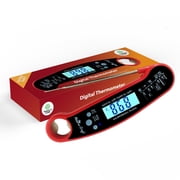
This wireless thermometer package includes the transmitter, the receiver, four temperature probes, and a couple of metal clips that you can use when a probe is not stuck into something you are cooking. The transmitter and receiver each require two AAA batteries, and those are included as well. I prefer gadgets that use common battery types like this, because I always have some around the house.
The parts appear to be of high quality. The four probes are fairly long, so large cuts of meat are no problem. The probes are color coded, so if you plug them into the corresponding connections on the transmitter it may help you remember what is what. You don't have to do so, of course, and you can use one to all four probes depending on your needs.
My unit worked out-of-the box. I installed the batteries in the transmitter and receiver, plugged in the probes, and both units began displaying probe temperatures. No “pairing†was necessary. The probes register temperatures the same or very close to what I see from a Thermapen instant read thermometer. No tools were required to install the batteries. The battery compartments in each piece are surrounded with a rubber seal, so this unit will probably withstand less than perfect weather conditions.
Both units have magnets on the back, so you can stick them on a metal surface. The transmitter has a flip out stand. The receiver has a clip that will work on a belt or pocket, and the clip can be folded out to make a stand. This strikes me as very well-thought-out design.
I don't always use all four probes, but it is a big convenience when cooking several thick steaks to different temperatures. It is also great for cooking a large cut of meat — a whole hog, for example — where you want to monitor temperature in different parts.
The probes can be stuck in what you are cooking, of course, or you can position them to measure the air temperature in a grill or oven. This is especially useful for cooking barbecue.
The temperature alarms can be set individually for each probe. You can set each alarm to trigger when a specific temperature is reached, or you can set alarms to trigger when the measured temperature is outside a specified range. The latter is useful, for example, when you want to keep your cooker at a steady internal temperature for “low and slow†cooking.
My only complaint that the package does not include a case for the transmitter, receiver, and probes. None of this stuff is very fragile, but careful storage will certainly extend its useful life. I made a partitioned wooden storage box. ThermoPro also makes a storage case (about $18), but it doesn't look like it has space to store all four of the probes with this unit.
Other than the lack of a case, I'm very satisfied with this unit.