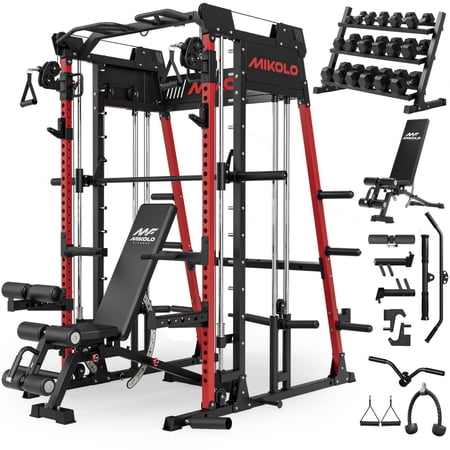
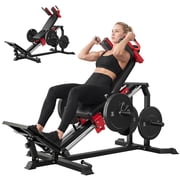
I put it together by myself, and it took most of the day. It’s a sharp‑looking unit once assembled. I followed the included instructions, but you can also find YouTube videos for the Mikolo M4 2.0, which is almost identical in layout. Pay close attention to the steps that say to finger‑tighten vs. fully tighten — that matters later. I highly recommend using real tools (socket wrench, open‑end wrench, folding hex keys, drill/driver with socket adapter). It does come with tools, but they’re very basic.
Some parts of the instructions were a little vague, especially when it came to installing the individual weight plates. The plates are definitely cement, and none of them are labeled — no stickers included either. I ended up using a thermal label maker to mark the weights (both actual and 2:1 effective). Each plate is 13 lbs, and the top weight horn is also 13 lbs. I’m guessing that odd number is why they didn’t bother labeling anything.
This is essentially the M4 2.0 with a number of downgrades and a few upgrades. Given the choice, I would choose the M4 2.0 with the weight stack and aluminum pulleys over this M11. I've outlined the downgrades/upgrades I observed below. Outside of these, the unit appears identical otherwise.
Downgrades from the M4 2.0
- Weight stack uses cement plates instead of steel. The Q%26A for the M4 2.0 on their website mentions that steel is better than concrete. It is too bad they cheaped out on this.
- No labels or stickers for the weight plates
- Smith bar ends are plastic‑coated instead of chrome
- Leg holder/step‑up combo replaced with a simple leg holder (no step‑up function)
- Springs removed from the bottom of the weight stack — now just rubber bushings
Upgrades from the M4 2.0
- Aluminum pulleys (big improvement in smoothness)
- Weight horn on top of the stack now includes a pin holder